Commercial Fitout Checklist Sydney: What to Confirm Before You Sign Your Lease
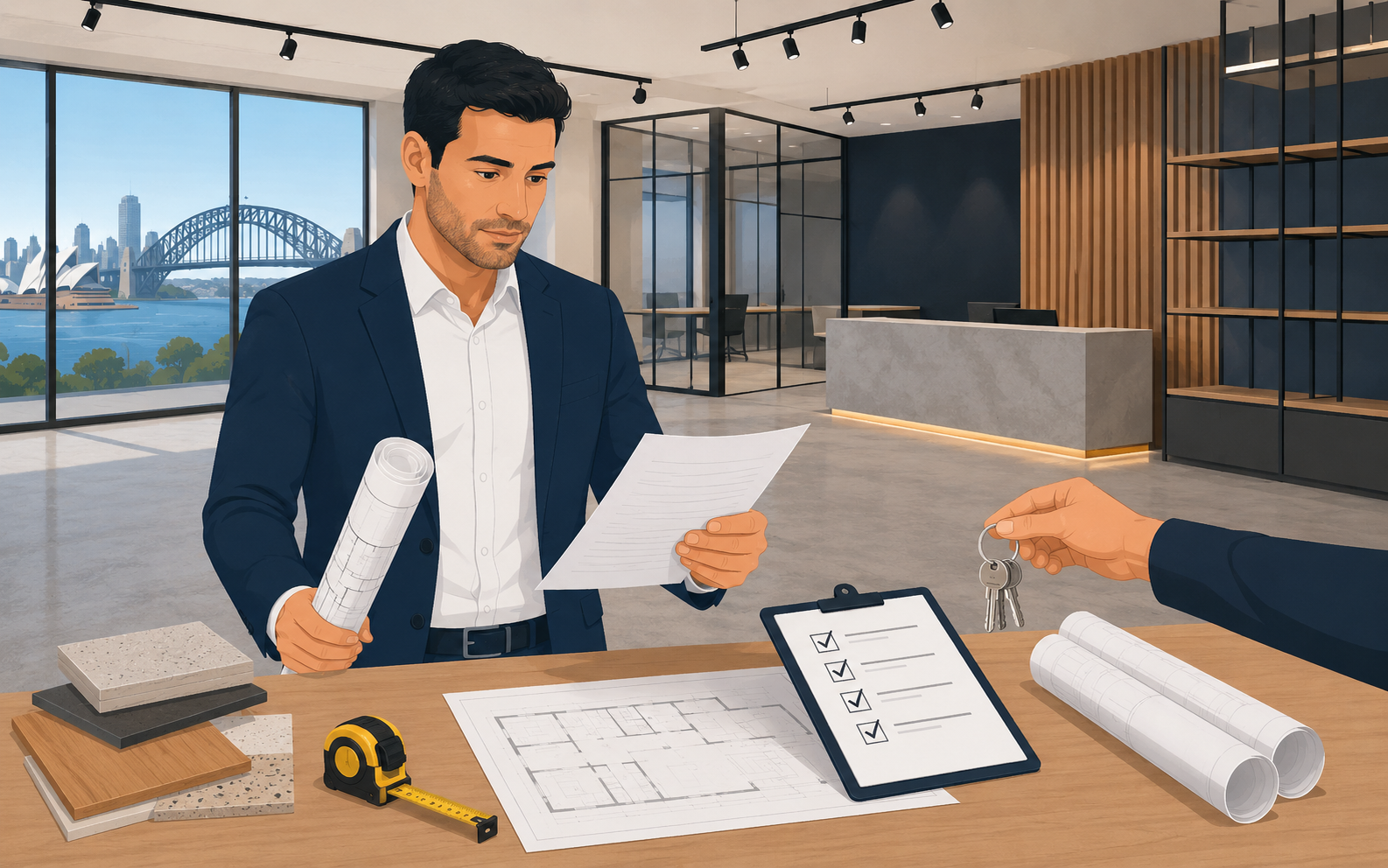
Most commercial fitout problems in Sydney don't start on site. They start in the lease. By the time a contractor is engaged, the tenancy's condition, the landlord's approval requirements, and the obligations a business owner has agreed to are already fixed. If those details weren't checked before signing, they usually surface later as a budget blowout, a delayed opening date, or an unexpected make-good bill at lease end.
This checklist is designed to be worked through before you sign a commercial lease in Sydney, so your fitout is planned around a tenancy you actually understand, not one you're still discovering.
Why Lease Terms Decide Your Fitout Outcome Before Construction Starts
A commercial lease isn't just a rental agreement; it's the document that sets the boundaries of what your fitout is allowed to be. It determines:
- Whether you need landlord consent before design work begins
- What condition must you return the space to when the lease ends
- Who pays for base building upgrades if services aren't sufficient
- How much time do you actually have between lease commencement and your planned opening date
Businesses that treat the lease and the fitout as two separate conversations tend to be the ones that discover, mid-project, that a clause they didn't read is now driving their budget.
Understanding Your Fitout Category First
Not every commercial tenancy starts from the same point, and the category of space you're leasing determines how much fitout work is actually required.
Sydney commercial tenancies are generally categorised as Shell & Core, Category A, Category B, or Turnkey, each representing a different level of base building completion before your fitout begins. A Shell & Core space with no internal services will require a far larger scope (and budget) than a Category A space that already has ceilings, lighting and air conditioning in place.
Understanding which category applies to your tenancy, as
explained in more detail on our North Shore fitout page, should happen before you agree to a budget or a handover date, not after.
The Lease Clauses That Directly Affect Your Fitout Budget and Program
Make-Good Obligations
Most commercial leases require the tenant to return the premises to their original condition or an agreed condition at lease end. This is known as a make-good clause, and it's frequently underestimated. If your fitout includes structural changes, service modifications or custom joinery, the make-good cost can be high, and it should be budgeted for from day one, not treated as a future problem.
Landlord Consent and Design Guidelines
Almost all commercial landlords, particularly shopping centre landlords, require design and construction guidelines to be followed and consent to be obtained before works commence. This typically includes shopfront design, signage, materials and construction methodology. Confirming
what your landlord's design guidelines actually require, before your designer starts documentation, avoids costly redesign later.
Fitout Incentives and Rent-Free Periods
Many landlords offer a fitout contribution, rent-free period, or other lease incentive to offset construction costs. These come with conditions, often around approved contractors, specification standards, or completion timeframes. Understanding what's tied to the incentive before signing protects both your budget and your flexibility in choosing a contractor.
Access Hours and Building Management Approval
Occupied buildings, strata-titled properties and shopping centres often restrict construction hours, require contractor inductions, and control loading dock or lift access. These restrictions directly affect how long a fitout takes and should be factored into your program before a handover date is agreed, not discovered once construction starts.
Approvals You'll Need Before Construction Begins
Beyond the lease itself, commercial fitouts in NSW typically require several layers of approval:
- Landlord or centre management approval reviewing your design against the base building specification and any fit-out guide.
- Construction Certificate (CC) issued by a registered certifier confirming the fitout complies with the National Construction Code (NCC) and relevant Building Code of Australia (BCA) provisions, including fire safety, egress and accessibility requirements.
- Development Application (DA) only required in specific circumstances, such as a change of use, heritage considerations, or external building modifications. Most standard commercial fitouts fall under an exempt or complying development pathway and don't require a full DA.
- Occupation Certificate (OC) confirms the completed fitout is safe and compliant for occupation and is required before your business can legally open.
Approval timeframes vary significantly, from a couple of weeks for a straightforward Construction Certificate to eight or more weeks where a DA applies. This is exactly the kind of detail that should be checked during lease negotiation, not after signing, since it directly determines whether your planned opening date is realistic.
For a full breakdown of how compliance is managed once construction begins, our FAQs page covers BCA compliance, certification and program protection in more detail.
A Practical Pre-Lease Fitout Checklist
Before signing a commercial lease in Sydney, confirm:
- What fitout category applies to the space (Shell & Core, Category A, Category B, or Turnkey)
- Whether the lease includes a make-good clause, and what condition it requires at lease end
- Whether landlord or centre management design/construction guidelines apply
- What approvals are required (landlord consent, Construction Certificate, and whether a DA applies)
- Whether any fitout incentive, rent-free period or landlord contribution is offered and what conditions apply
- Whether the base building services (power, mechanical, hydraulic) are sufficient for your intended use
- What access restrictions apply during construction (hours, inductions, loading dock bookings)
- Whether a bank guarantee or security bond is required, and how it interacts with fitout costs
- How much time realistically exists between lease commencement and your planned opening date
How Your Industry Changes What You Need to Check
The specifics of this checklist shift depending on what you're fitting out:
- Retail tenancies involve shopfront approval, signage restrictions and strict lease commencement deadlines covered on our Retail Shop Fit-Outs page.
- Café and hospitality spaces carry additional requirements around mechanical ventilation, grease traps and fire safety detailed on our Café & Hospitality Fit-Outs page.
- Office tenancies often involve partitioning, workstation planning and staff relocation logistics, outlined on our Office & Workplace Fit-Outs page.
- Gym and wellness spaces need structural and acoustic assessment before a lease is signed, not after; see our Gym & Fitness Studio Fit-Outs page.
- Medical and allied health tenancies carry the strictest compliance load, particularly around accessibility and treatment room layout, covered on our Medical & Allied Health Fit-Outs page.
- And if you're exiting a tenancy rather than entering one, make-good obligations are addressed directly on our Commercial Refurbishments & Make-Goods page.
Where Location Adds Complexity
Building conditions, council requirements and landlord expectations vary noticeably across Sydney. We work through these specifics for tenancies across the Inner West, Eastern Suburbs, and North Shore, each with different precinct-level considerations worth understanding before you commit to a specific address.
Getting It Right From Day One
A commercial lease is the foundation your fitout is built on. Reviewing it properly, ideally with both a lawyer and a fitout specialist involved before you sign, is what separates a project that opens on schedule from one that starts with a compliance surprise already baked in.
Monument Fitouts works with business owners at this exact stage, assessing tenancy condition, lease obligations and realistic timelines before construction begins. You can read more about our approach and licensing on our About Us page, or book a Commercial Fitout Feasibility & Budget Assessment before you commit to a lease.
Recent Posts