Which Is Right for You: Commercial Office Fitout vs Refurbishment
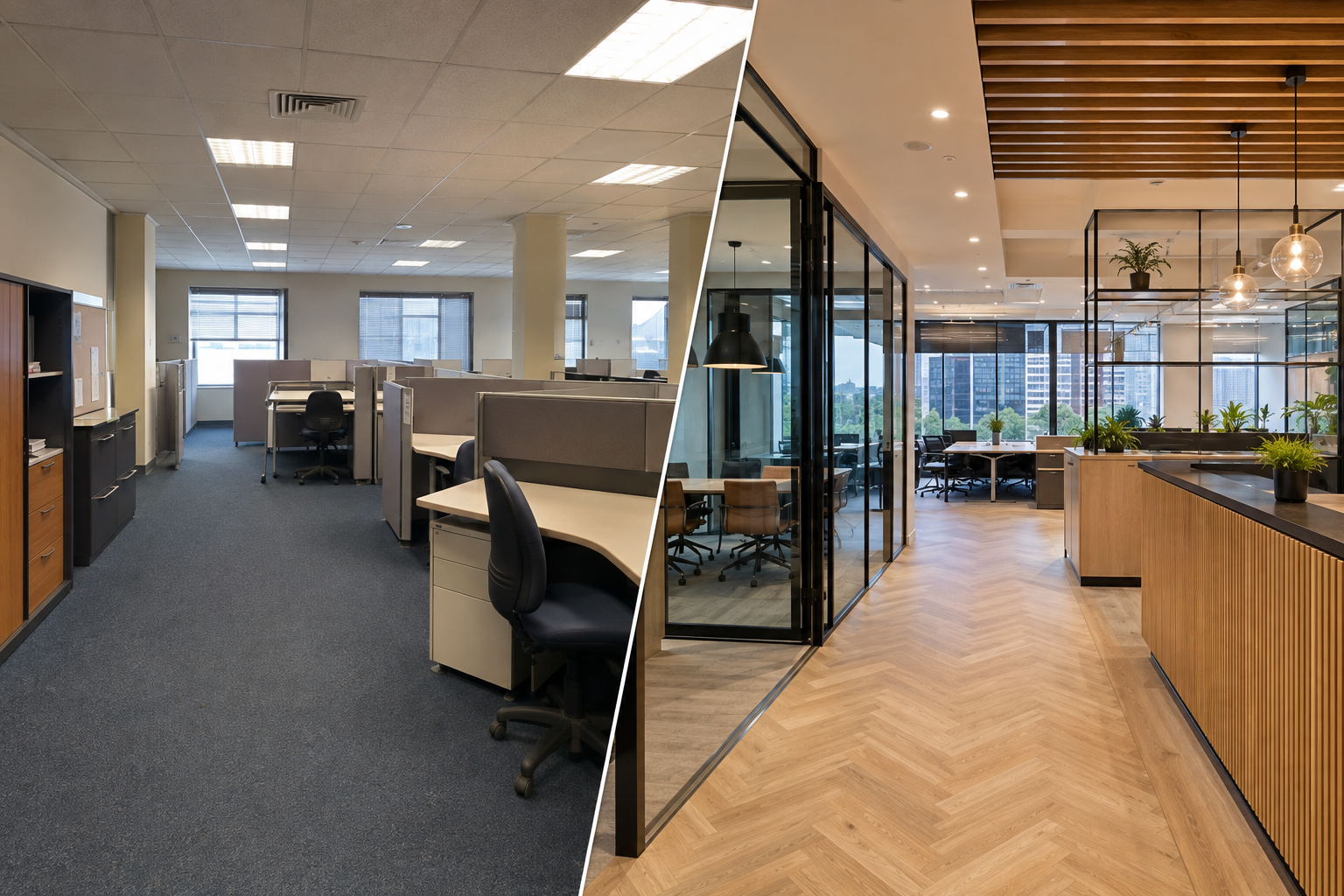
If you're moving into a new lease, growing out of your current space, or just tired of walking into an office that looks stuck in 2012, one question comes up before almost anything else: do you need a full fit-out, or would a refurbishment get you there in less time, with less budget and less disruption?
The two terms get used interchangeably by a lot of businesses, but they describe genuinely different scopes of work. Getting it wrong in either direction means paying for construction you didn't need, or under-scoping a project that has to be redone within a couple of years. This guide breaks down what actually separates a fitout from a refurbishment, and how to work out which one applies to your space.
What Determines Whether You Need a Fitout or a Refurbishment
Before comparing the two, it helps to understand what actually drives the decision. Most projects come down to:
The starting condition of your tenancy, whether it's Shell & Core, Category A, Category B, or an already-fitted space you're staying in
Whether the existing layout works functionally, or needs to change entirely
The condition of existing services, including electrical, data, HVAC and plumbing infrastructure
Your lease terms, including whether you're relocating, renewing, or extending
Your budget and timeline, and how much disruption to operations is realistic
Two businesses in a similar-sized office can land on completely different answers simply because one is moving into an empty Shell & Core tenancy and the other already has a fully built-out Category B space that just needs updating.
What a Fitout Involves
A commercial fitout transforms a space from an empty or partially finished shell into a fully operational business environment. It typically includes partitions, joinery, electrical and data infrastructure, flooring, ceilings and finishes, all built specifically around how your business operates.
Fitouts are most common when:
- You're moving into a new tenancy that's Shell & Core or Category A and isn't yet functional
- Your current layout doesn't work at all, rather than just looking dated
- You need infrastructure that doesn't currently exist, such as additional data cabling, HVAC zoning, or a kitchen and bathroom fit for a hospitality or medical use
- You're growing significantly and need a layout designed around a headcount or workflow that didn't exist when the space was last built
- Your lease commencement date is fixed, and the full space needs to be ready to operate from day one
What a Refurbishment Involves
A refurbishment updates and improves an existing, already-functional space without starting from a blank slate. It might mean new flooring and paint, reconfigured partitions, updated joinery, or a general modernisation of a layout that already works structurally but looks or performs poorly.
Refurbishments are most common when:
- The existing layout largely works, and the issue is dated finishes or a look that no longer reflects the brand
- You're staying in your current tenancy rather than relocating
- Budget or timeline is tighter, and a full rebuild isn't necessary to solve the problem
- Only part of the space needs work, such as reception, meeting rooms, or a breakout area, while the rest stays functional
- The building's core infrastructure is already sound, meaning services and layout don't need to be rebuilt from scratch
How Your Industry Changes the Decision
The type of business also shapes whether a fitout or refurbishment applies, and how much scope either one involves.
Retail tenancies often need a full fitout when shopfront approvals, signage and strict lease commencement deadlines are involved, covered in more detail on our Retail Shop Fit-Outs page.
- Café and hospitality spaces frequently require a fitout rather than a refurbishment once mechanical ventilation, grease traps and fire safety coordination are needed, as outlined on our Café & Hospitality Fit-Outs page.
- Office fitouts depend on partitioning, workstation planning and staff relocation logistics, detailed on our Office & Workplace Fit-Outs page, and are often where the fitout-vs-refurbishment decision is closest.
- Gym and wellness spaces usually need structural and acoustic assessment early, which can push a project toward fitout territory even in an existing tenancy, explained on our Gym & Fitness Studio Fit-Outs page.
- Medical and allied health tenancies carry the strictest compliance load, particularly around accessibility and treatment room layout, covered on our Medical & Allied Health Fit-Outs page, and can require a fitout even where the base space looks largely finished.
- If you're exiting a tenancy rather than upgrading one, that's a different scope again, addressed on our Commercial Refurbishments & Make-Goods page.
How Fitout Category Changes the Comparison
The starting condition of your tenancy has one of the biggest effects on whether fitout or refurbishment applies:
- Shell & Core: no internal services or finishes. Always requires a full fitout, refurbishment isn't an option because there's nothing to refurbish yet.
- Category A: ceilings, basic lighting and mechanical services are usually in place. Can go either way depending on how much of the space needs to change.
- Category B: largely fitted out already. Often a refurbishment candidate, unless the layout itself needs to change significantly.
- Turnkey or an existing tenancy you're staying in: almost always a refurbishment question rather than a fitout one, since the infrastructure and layout already exist.
- Confirming which category applies to your space before assuming either direction is one of the more reliable ways to avoid over-scoping or under-scoping the project.
Common Reasons Businesses Choose the Wrong One
Most mismatches between project and outcome come down to a small number of recurring issues:
- Assuming a tired-looking space needs a full fitout when the underlying layout and services are actually sound
- Scoping a refurbishment for a space that turns out to have insufficient base building services once work begins
- Underestimating how much a business has grown, and refurbishing a layout that's already too small for current headcount
- Not confirming lease terms and landlord consent requirements before committing to either scope
- Treating the decision as a style preference rather than a functional assessment of what the space can and can't do for the business
- Most of these are avoidable with a proper site assessment before the scope is locked in, rather than after.
How Monument Fitouts Helps You Decide
At Monument Fitouts, every project starts with an assessment of the actual space, not a default assumption of fitout or refurbishment. We review your lease, your existing infrastructure and your business goals, then recommend the scope that genuinely fits, backed by a fully documented, fixed-price contract so there are no surprises once construction starts.
Whether that turns out to be a full fitout, a refurbishment, or a mix of both across different parts of your space, every project is backed by our contractual $500 per day delay credit if practical completion is missed due to factors within our control (conditions apply).
Recent Posts